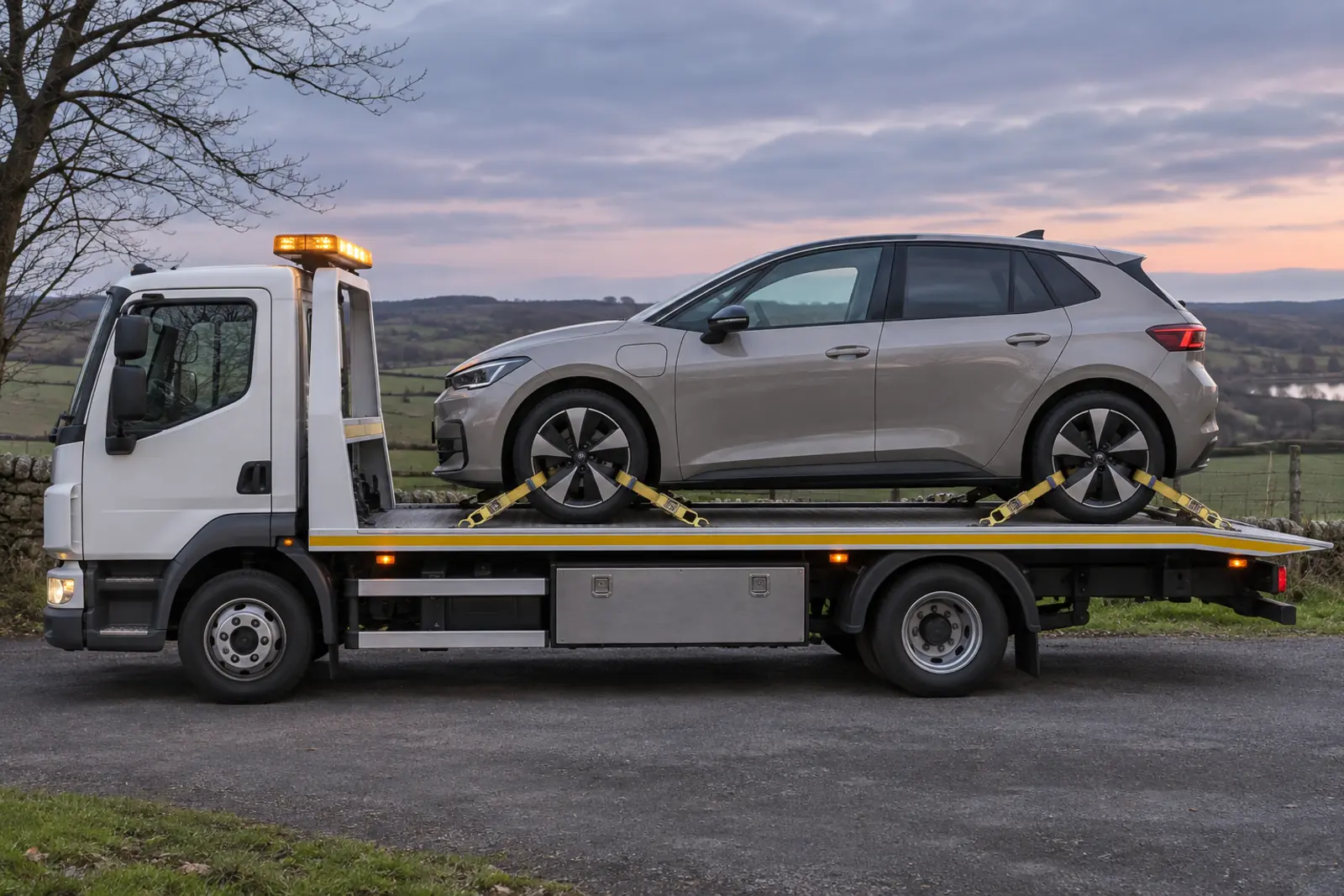
Yes, an electric car can be towed, but it should almost always go on a flatbed with all four wheels off the pavement, unless the owner's manual for that exact model says otherwise. The motor stays mechanically linked to the drive wheels, so dragging them along the road can force the motor to spin and can damage it and the electronics around it. The practical rule for a driver around Leicester is simple: say "electric" or "hybrid" in the first sentence of the call, ask for a flatbed, and keep the manual's towing page handy on your phone.
Can you tow an electric car without a flatbed?
Only if the manufacturer allows it for that model, and few do. Many owner's manuals say to transport the car with all four wheels off the ground, because turning the drive wheels on the road can damage the motor. An all-wheel-drive car adds a second problem: lifting one axle still leaves the other motor connected to the road.
The detailed comparison of the two truck types lives in the guide to flatbed and wheel-lift towing. For an electric car, the short version is to ask for the flatbed and treat any other method as something the manual must approve in writing.
Why electric and hybrid cars are different
A gasoline car in neutral can often be rolled a short way on its wheels. An electric car is a different machine. There is no conventional transmission to disconnect, and the motor can act as a generator when the wheels turn it. Many manufacturers therefore list flatbed towing as the only approved method, and some also warn against dollies that leave one axle on the road. Hybrids vary more: some are fine for limited wheel-lift towing, many are not, and the only way to know is the manual.
A wrong choice can turn a simple tow into a repair bill that dwarfs the tow itself, and damage from improper transport may not be covered by a warranty.
What to say on the first call
Dispatchers send whatever truck is closest and free. If they do not know your vehicle is electric, a wheel-lift truck may show up. Give the dispatcher these details, in this order:
- The vehicle type. "Battery-electric," "plug-in hybrid" or "regular hybrid," plus make, model and year.
- The truck you need. Ask for a flatbed, and ask whether the driver has loaded an electric vehicle before.
- The condition. Say if the car has power, if the screen is dark, if it will shift into neutral and whether the 12-volt battery might be dead.
- Your exact location. The steps in how a tow call works apply as usual, and a flatbed needs room to tilt and load.
If you are not sure which company to call, the checklist in how to choose a tow truck company helps you screen for the right equipment before anyone is dispatched.
Towing a Tesla and tow mode
Tesla and some other makers use a software setting, often called Transport Mode or Tow Mode, that keeps the parking brake released so the car can be winched onto a flatbed. It is meant for loading only. On a touchscreen car the setting is usually found in the vehicle's service or towing menu, and it generally needs the car to be awake and the 12-volt system to have power. The exact steps differ between models and model years, so check the manual for the exact car.
Most other electric cars have a similar setting under a different name. It generally releases the parking brake and lets the car roll so it can be winched onto a flatbed. It does not make the vehicle safe to drag down the road on its drive wheels.
Tow mode, neutral and the dead 12-volt battery
The catch is that these settings usually live on a touchscreen or a button that needs power. Electric and hybrid cars also run a small 12-volt battery for the screens, locks and controls, separate from the big traction battery. If that smaller battery is dead, the car can look completely lifeless even when the main battery is full. The usual order of work is:
- Restore 12-volt power by a jump or a booster pack, following the manual's jump points.
- Switch on the tow or transport setting, or put the car in neutral, as the manual directs.
- Release the parking brake if the manual says to.
- Load onto the flatbed with the driver using the tie-down points the manufacturer specifies.
Some models have a manual release procedure for a dead 12-volt battery, and some need a scan tool. Ask the driver to read the manual instead of improvising, and do not let anyone pry the car around with the wheels locked. The guide to roadside help covers what a jump start involves and what can be done on the spot.
How to tow a hybrid car
A hybrid has an engine and one or more electric motors, and its transmission usually cannot be left free to turn the way a conventional gearbox can. The safest default is the same as for an electric car: a flatbed. Towing a hybrid with its drive wheels on the road can damage the transmission or motors, so a wheel-lift tow is only an option if the manual for that model allows it.
Some manuals also describe an emergency procedure for short moves, which typically involves releasing the parking brake and putting the car in neutral with the hybrid system active. Follow that only if the manual for your model describes it and a flatbed is truly unavailable. Plug-in hybrids and all-wheel-drive hybrids can be stricter than a basic hybrid, so do not assume the rule for one car applies to another.
Common situations and the right call
| Situation | Usual best approach | Watch out for |
|---|---|---|
| Out of charge, battery empty | Flatbed to a charger or home; some roadside programs may offer a charge, so ask | A truck that cannot load a car that will not shift |
| Dead 12-volt, car unresponsive | Restore 12-volt power, then tow mode, then flatbed | Pulling it with drive wheels down |
| Flat tire | Spare or sealant if equipped; otherwise flatbed | Many models carry no spare |
| Warning light, car will not drive | Flatbed to a shop that works on that model | Choosing a shop with no high-voltage experience |
| Hybrid, uncertain rules | Check the manual's towing page, default to flatbed | Assuming all hybrids tolerate wheel-lift |
After a crash
A damaged electric or hybrid vehicle needs extra care because the high-voltage battery can be harmed even when the body looks fine. Tell the responding officer and the tow company that the car is electric. Make sure the driver knows about any visible battery damage, smoke or fluid. The process described in the crash guide still applies, but expect the car to go to a facility that can store and inspect it properly. Ask where it is going, and ask the insurer which shops it will accept.
Mountains, cold and range
Many calls come from range rather than mechanical failure. Long grades, cold weather and heater use can all draw down a battery faster than a flat-road estimate suggests, and charging stations are less common on rural mountain roads than in town. Keep a margin, plan the charge before a steep stretch and read the cold-weather advice in the piece on winter breakdowns in the mountains. Being stuck is also a safety issue: leave hazards on, stay clear of traffic and call early. On a highway the steps in what to do when broken down on I-26, I-40 or I-240 apply, and on the Parkway see who to call after a Blue Ridge Parkway breakdown, where a flatbed may take longer to reach you.
What it may cost
Flatbed work is often priced differently from a wheel-lift tow, and a long run to a charger or a specialist shop adds mileage. Prices vary by company, hour and distance, so treat any figure as a rough range and verify it with the provider before you agree. The guide to what a tow costs explains the usual charges. Ask whether the quote already assumes a flatbed, and ask about storage fees if the car cannot be moved right away. Some auto clubs and insurers cover tows with different mileage limits, so check your policy first, and see whether insurance pays for towing for how add-ons and club plans usually work.
Frequently Asked Questions
Can you tow an electric car?
Yes, on a flatbed. Many manufacturers say the drive wheels should not turn on the road, because the motor is connected to them. Check the owner's manual for the exact model before the truck arrives.
Can an electric car be towed on a wheel-lift truck?
Usually not. Most manufacturers list flatbed towing as the approved method because the drive wheels spinning on the road can damage the motor and electronics. Your owner's manual is the final word for your model.
Can I put an electric car in neutral to tow it?
Many can be put into neutral or a tow mode for loading on a flatbed, but this is not permission to drag the car on its wheels. If the 12-volt battery is dead, the car may not shift until power is restored.
What does Tesla tow mode do?
It releases the parking brake so the car can be winched onto a flatbed. It is for loading only, not for towing on the road, and it generally needs 12-volt power to work.
Is a hybrid towed the same way as an electric car?
Not always. Some hybrids tolerate limited wheel-lift towing and many do not. Check the manual, and if you cannot find it, ask for a flatbed.
What if my electric car simply ran out of charge?
Call roadside assistance or a tow company, say that the car is electric and ask for a flatbed. Ask whether the provider can supply a charge; if not, the car goes to a charger or home.
Does a flatbed cost more than a regular tow?
It can, depending on the company and distance. Ask for the full quote, including mileage and any storage, before agreeing, and ask your insurer or auto club what it will cover.